Saturday, September 27, 2014

Clean Windows and Air

There's no denying that driving an electric vehicle charged by solar panels is doing my bit to minimize my impact on the climate.  But that's not what this post is about.  Driving a gasoline-powered car, you find the world has put in place certain extras to improve your driving experience.  Namely, when you stop at a gas station for a fill-up, you will likely have a squeegee handy to clean your windows and an air pump handy to top off the air in your tires.  When you drive an electric car, you give up gas station visits.  This is a mixed blessing.  True, you get to re-fill (charge) your car from the convenience of your own driveway each night and avoid stops at the gas station on your way home (or rushing to work).  But you lack those little conveniences that help keep driving a safer experience.

Because I park outside, my windshield dews up at night and gathers all the settling dust.  After a few mornings, a haze has formed that I must look through.  After a few more days, I am reminded that I need to clean the windshield every time I drive towards the setting sun.  If I catch this early enough, a few squirts from a bottle of Windex and a clean rag get the windshields back in shape.  The real problem is the tires.  This is where a bicycle pump becomes my upper-body cardio program.  Unlike my VW GTI, with its 225 width tires, the i-MiEV features much smaller 175 width tires in the back and 145 width tires up front.  The advantage these tires offer is that as few as twenty pumps of the bike pump can bring them back from a six PSI deficit.  The rear tires require a little more work, but it’s nothing like the 120 strokes the GTI requires.  If upper body strength (or sweat) is not your thing, then you can either buy an electric air pump, or return to the gas station every other month to top off the tires.  (I’m sure they miss you there and would welcome you back.)  Luckily, you don’t need a paper towel dispenser for checking the oil level each time.
A good-quality bike pump easily keeps the tires up to pressure when used monthly.

Saturday, September 20, 2014

Electric Vehicle Rally 2014 and World Record

Today, September 20, 2014, was time for the annual electric car rally put on by the Electric Automobile Association on Silicon Valley.  I had been looking forward to this event for weeks, as it’s my one chance to geek out and see what’s new in EV’s this year.  I had an opportunity to sit in a new Kia Soul electric and to test drive a Fiat 500e.  I found the Fiat to be a bit more “normal” feeling than my Mitsubishi i‑MiEV, but I prefer the interior utility of my car.  There was a converted Porsche convertible from 1958 which had a 60hp motor and lithium-ion batteries.  I also spotted a guy standing on what amounts to a motorized wheel.  The device is controlled via foot actions on the pedals upon which the rider rests.  There were also several companies selling infrastructure or apps related to charging electric vehicles.  But my favorite exhibit remains the electric bathtubs.  These tiny fiberglass bathtub shells, complete with spigots, are little electric cars (along the lines of Barbie’s cars) that kids can drive around in a small coral.  (I was told I could try one, but I was afraid I wouldn’t be able to extract myself afterwards.)

Electric-powered bathtub cars for the kids
Of course, all of these exhibits paled in comparison to the main draw of the event.  It would seem that earlier this year the good citizens of Stuttgart, Germany, got together and assembled a parade consisting of 481 battery electric vehicles (no gas engine hybrids) and made their way into the book of world records.  Earlier this week came word that Silicon Valley was going to break that record.  With little notice, and even less marketing, we cobbled together a band of hundreds of electric cars.  Each car was registered ahead of time and had to present credentials for driving on the road.  We all filled nearly two parking lots at the community college where the event was held.  There were low-flying drones capturing a record of the event, and countless smartphones snapping pictures and videos.  By the time I had arrived, most of the drivers had filled the main parking lot and were overflowing into a second.  Finally came the call to start.  I did some math and estimated that 500 cars spaced 30-feet (front-to-front) would occupy about three miles.  Sure enough, just before my section from the parking lot departed, I could see the first cars arriving from the two-mile loop.  The official count for the parade was 507 electric vehicles, breaking the Stuttgart record by 26.  There was a loud cheer as the officials announced the final tally. 

The official world record plaque
As I was stuck in traffic trying to pull into the parking lot, and during the two-mile loop around the college, I could not help but notice two things.  First, electric cars really are quiet.  There was no droning of gas engines idling, waiting to inch each car forward.  There were no exhaust fumes from the other cars either.  If this is the traffic jam of the future, I’m all for it.  The second thing I noticed was how well electric cars drive at slow speeds.  My gasoline-powered car is a blast to drive at highway speeds and through the mountains because of its manual transmission.  But creeping along at 4 to 6 MPH is a task that wears on your left foot and is anything but smooth.  Likewise, the small rental car I drove last week was jumpy off the start, lurching forward and unable to get going smoothly.  By contrast, the electric car gets going and maintains these speeds easily, comfortably, and quietly.  Again, driving in heavy traffic is best enjoyed in an electric vehicle.  I still prefer the wide-open roads, but now I don’t object so much to congestion.
The parade of all-electric vehicles (including conversions)

Sunday, September 14, 2014

The range gauge

When your car carries the equivalent of two or three gallons of gasoline, it is very important to have a good idea how far you can drive without recharging.  Electric car manufacturers understand this and include a driving range gauge.  In the Mitsubishi i-MiEV, the range is displayed by a multi-function gauge that shows eight different measurements, including the outdoor temperature and two different trip odometers.  When I first started driving the i-MiEV, I displayed the range gauge all the time while driving.  This gave me a pretty good idea of how it works.  The gauge reads the battery charge level, then estimates your range based upon the last 5 to 10 miles of driving.  If I finished my day with some city driving, the fully charged car will show 80 to 90 miles of range after charging the battery.  If instead I ended my driving with freeway miles, it will show only 65 to 75 miles of range.  This experience was a little unnerving to watch as the range dropped by 20 miles after having driven only 10 to 12 miles.  This rapid drop happens because the car acclimates to driving on the freeway and lowers its range estimate.  After exiting the freeway, the range stops dropping for a distance and sometimes even increases.

This ever changing impression of how far I can drive lead me to stop using the range gauge.  Instead, I rely mostly on the trip odometer, which I reset after every full charge.  I have learned (and the EPA has confirmed) that the car travels about 4 miles per “tick” (out of 16 ticks) on the charge-level gauge.  The freeway goes a little less per tick, and around town goes a little farther.  To estimate my driving range, I consider where I plan to be driving (city or freeway) and “do the math”.  If I have 9 ticks remaining on the charge, then I figure I can drive about 32 miles on the freeway to 45 miles around town.  Whenever the charge level drops below 4 ticks I switch to the range gauge.  With only 3 or 4 ticks left, I trust the car to know better how far I can drive.
My full-charge range after yesterday's freeway and city driving
So far I have not “turtled” the car or run the battery to empty.  “Turtling” happens when you drain all but a portion of the last remaining charge-level tick.  The car goes into an ultra-conservative energy management mode where the speed is limited to about 25 MPH.  This is indicated on the display using a small turtle graphic.  Because the i-MiEV allows its entire battery capacity to be depleted, turtling the car is not good for the longevity of the battery, though the occasional turtling should not be too harmful.  After about 27,000 miles, the batteries still seem to support the same driving range, so I am guessing that my driving and charging style is good for the car.  (On a similar note, I read that too frequent charging can also be hard on the battery – recharging while in the 25% to 75% charge range is ideal.)

Sunday, September 7, 2014

No more gas stations

I always think about how amusing it would be to pull into a gas station in my i-MiEV and ask for help finding where to connect the gas pump.  Somehow, the rational side of my brain says not to do that, so I only visit the gas station on those rare times that I have forgotten to clean the windshield and I’d really like to see out of the car.  That amounts to six or ten visits to a gas station a year.  My new service station is in my driveway. 

Every night, after 9:00pm (when the electric rates drop for me), I plug in the car.  The next morning I awaken to a full charge.  This is the trade-off with a gasoline powered car: no more hanging around the gas station.  The biggest problem is dust and dirt build-up on the wind shield, but that is easy to clean off (if you remember to do it).  Checking the tire pressure is more important in an electric vehicle, and I find that the skinny tires on the electric car need only about a dozen pumps from a bicycle pump each month to keep them maintained.  There is no oil to check.  And best of all, there’s no waiting for a pump.  Of course, I don’t get many opportunities outside of work to interact with the world, and the gas station used to be one of them.  Somebody needs to combine electric-car charging stations with coffee, laundry, and other social activities to get us back into the world.

An ordinary bike pump easily keeps my tired inflated.


Monday, September 1, 2014

Odd Looks and Thumbs-Up

I can tell that the Mitsubishi i-MiEV has not become a sales hit here in the U.S.A. the way that it has in Europe and Japan.  Nearly every time I drive somewhere, I get odd looks from people trying to figure out what the curious purple car is driving by.  (I call it the “electric grape”, but one friend calls it the “purple bean”.)  Some people smile once they figure out that the car is electric.  Some point discretely from within the privacy of their own vehicle.  Others never get that far in the thought process.  Usually, the larger the vehicle, the more puzzled the look on the driver.  I once stopped into a Starbucks as a lifted Ram 2500 turbo-diesel was pulling up.  I had a brief chat with the driver about the car before returning to the road.  I have to admit that the difference in mass between our two vehicles was a little frightening.  Another time, I had parked and run into a grocery store.  By the time I came out, another i-MiEV owner had parked his car next to mine.  For me, that was a Kodak moment.  (Too bad Kodak got out of the Kodak-moment business.)
A Kodak Moment happened when I returned to my car after shopping.
But of all the interactions I have had with fellow drivers and roadside gawkers, the most memorable happened within the first two weeks of getting the car.  It was a breezy, rainless day after Christmas.  The sun was lingering just above the hilltops, threatening to darken the area soon.  I was driving up a fairly busy residential street when I passed a fellow working in his yard.  He must have seen my car approaching (because it’s really hard to hear it) and had time to check it out.  As I drove past, he gave me a big thumbs up of approval.  This one reaction is probably the most gratifying I have experienced to date.

Wednesday, August 27, 2014

My level-2 home charger

The first thing you need to get for your electric vehicle is a level-2 EV charger (220-volts).  This makes it possible to charge your car in a few hours rather than the better part of a day.  In my case, a full charge when plugged into a 110-volt outlet takes up to 22 hours.  With my commute to Palo Alto, the 110-volt charging solution was not a feasible option.  Of course, being the first i-MiEV customer in San Jose meant that the dealership was horribly unprepared to help me get a level-2 charger installed, and the folks from Best Buy (sent by Mitsubishi) dropped the ball and were no help (especially so close to Christmas).  I checked at Lowes and Home Depot and found a GE charger for $1,000 and a mystery-brand model for $800 that only offered 20 amps of charging capability (about half the GE’s).  Although my car would never draw more than 14 amps, I felt that newer EV’s (such as from Tesla) might be able to draw more current and I wanted a capable charger.  So, I turned to the internet for help.
My EV Charge America level-2 charger installed outdoors

I found the website for EV Charge America and their 32-amp EV charger being offered at an introductory price of $650, and placed my order.  Because they were still pre-production (something I wasn’t aware of), I had to wait about six weeks for them to work out the production kinks in their pilot-production models.  They shipped me one of these pilot-production models, then canceled their production plans.  (While shocking – pun – the unit provided has worked beautifully since day one.)  Next, I hired an electrician and applied for a permit.  The electrician installed a beautiful outdoor 220-volt receptacle and I mounted the charger to the house wall with four easy screws.  (I needed to whittle away at the receptacle housing to get the cover to close over the beefy electrical cord for the charger, but otherwise it was an easy installation.) 
I needed to file away at the opening for the power cord so the plug would fit.

Now I have a charger that can only be activated by a RFID card I keep in the car, so I don’t have to worry about amp-bandits tapping my house during the day while I am at work.  The RFID card can be hit-and-miss at times, but with a little patience it works well.  And, I charge at home while I sleep, avoiding those 5 to 10 minute stops at gas stations every week.  How cool is that?  And, my charger has the extra capacity needed for my next generation of EV, which looks to be hitting the roads sometime in 2017.

Friday, August 22, 2014

My commute

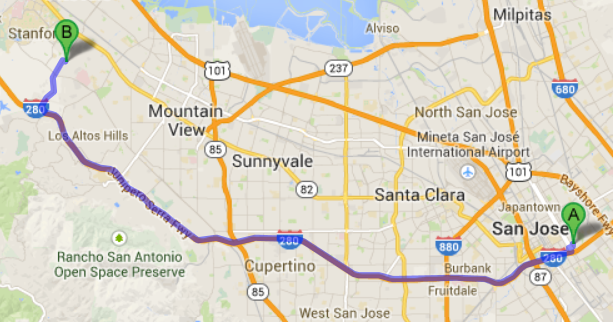
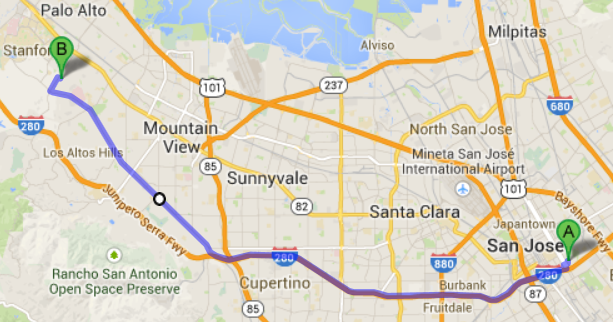
Before committing to buying my electric i-MiEV, reports had spread throughout work that we would be relocating from the Cupertino campus to the Palo Alto campus in the coming 12 to 18 months.  My coworkers and I had hoped this wouldn’t happen, because we had all purchased properties in proximity to the Cupertino campus.  My coworkers would go from driving two miles to driving about ten miles, while my commute would grow from 10 miles to about 20 miles (each way).  So, I plugged my home address and work address into Google Maps and saw that there were four practical routes to work for me.  One involved driving mostly on the most congested freeway cutting through Silicon Valley, another involved endless stoplights on a slower-speed expressway, and then two more involved taking the freeway that passes closest to my house.  The difference between these last two routes was in the last 8 miles.  On one, I would stay on the freeway and drive over rolling foothills, while the other traveled a slower, more level expressway with traffic signals.  This last route would add about five minutes or so to my travel time, was one-mile shorter, uses less electric charge, and has become my route to work.

The fastest route to work

The slower, shorter, more level route to work
During the Christmas shutdown, I decided to test out my future route to work to see how the car would fare.  I decided to drive at the speed limit (65 MPH) along the entire stretch of freeway, not using the car’s Eco mode, to get an “upper bound” on how much electricity I would use.  When I arrived at the office site in Palo Alto, I had used one third of the charge, meaning I could drive to and from work without any worry of running out of juice.  In fact, there would still be about 18 to 24 miles of driving range remaining when I arrived at home afterwards, which is enough to run to the store or go out for dinner.  As it turns out, I always use the car’s Eco mode when commuting and I keep the speed closer to 60 MPH, resulting in using almost 15% less electricity used for the same drive.  Over time, this savings becomes significant.